
Birmingham City Directory Shelves
Birmingham has a long directory record, but it is spread across several kinds of shelves. The Birmingham Public Library Southern History Department holds the main run. The Alabama Department of Archives and History, or ADAH, provides a second set with many city and suburban editions. Free digital items include specialty books rather than a complete residential run. A later telephone book can add phone and address data, yet its service area can reach well beyond Birmingham city limits.
| Collection | Years | Where Held | Access |
|---|---|---|---|
| Birmingham city directories | 1883 to present, with four absent years | BPL Southern History | Reference use in originals or microfilm |
| ADAH Birmingham directories | Discontinuous runs, 1888 to 2007 | ADAH research room | Finding aid and on-site research |
| Specialty directories | 1887 and 1913 examples | BPL digital collections | Free online |
| South Central Bell white pages | June 1971 example | Library of Congress | Free online |
The table distinguishes a collection from a single edition. BPL says its run begins in 1883 and continues to the present, but that wording does not prove every recent year is a printed residential book. Ask staff for the latest format and year. ADAH lists strong runs from the late nineteenth century through the twentieth, plus scattered later volumes. Its exact sequence includes 1888 through 1891, 1893, 1895 through 1896, 1900 through 1901, and many later groups. The two repositories can fill different gaps without being treated as identical copies.
Birmingham Directory Years Since 1883
Birmingham was founded in 1871, and the local directory run starts just twelve years later. That timing makes the volumes useful across nearly the whole mature industrial-city period. Verified publishers in authoritative holdings include R. L. Polk & Co. and Malone & Co. Roberts & Son published the 1913 Blue Book, a specialty item that should not be read as if it were a standard residential Polk volume.
A compact timeline keeps those shifts clear:
- 1871: Birmingham is founded at major rail crossings.
- 1883: BPL's principal Birmingham directory run begins.
- 1887: a Pocket Business Directory survives in the digital collection.
- 1913: the Roberts & Son Blue Book records a different social and business slice.
- 1971: South Central Bell white pages show a broader metro phone footprint.
Directories are dated snapshots. A canvass may have occurred before the cover year. A missing name can reflect a move, death, omission, spelling choice, or timing. Check the year before and after before drawing a conclusion.
Birmingham Southern History Access
The Southern History Department access page is the practical starting point for the main historical shelf. It is on the first floor of the Linn-Henley Research Library, 2100 Park Place. The department lists appointment-only service Monday through Friday from 9 a.m. to 6 p.m. and can be reached at 205-226-3665. Materials are reference-only, so plan to take notes and request allowed copies rather than remove a volume.
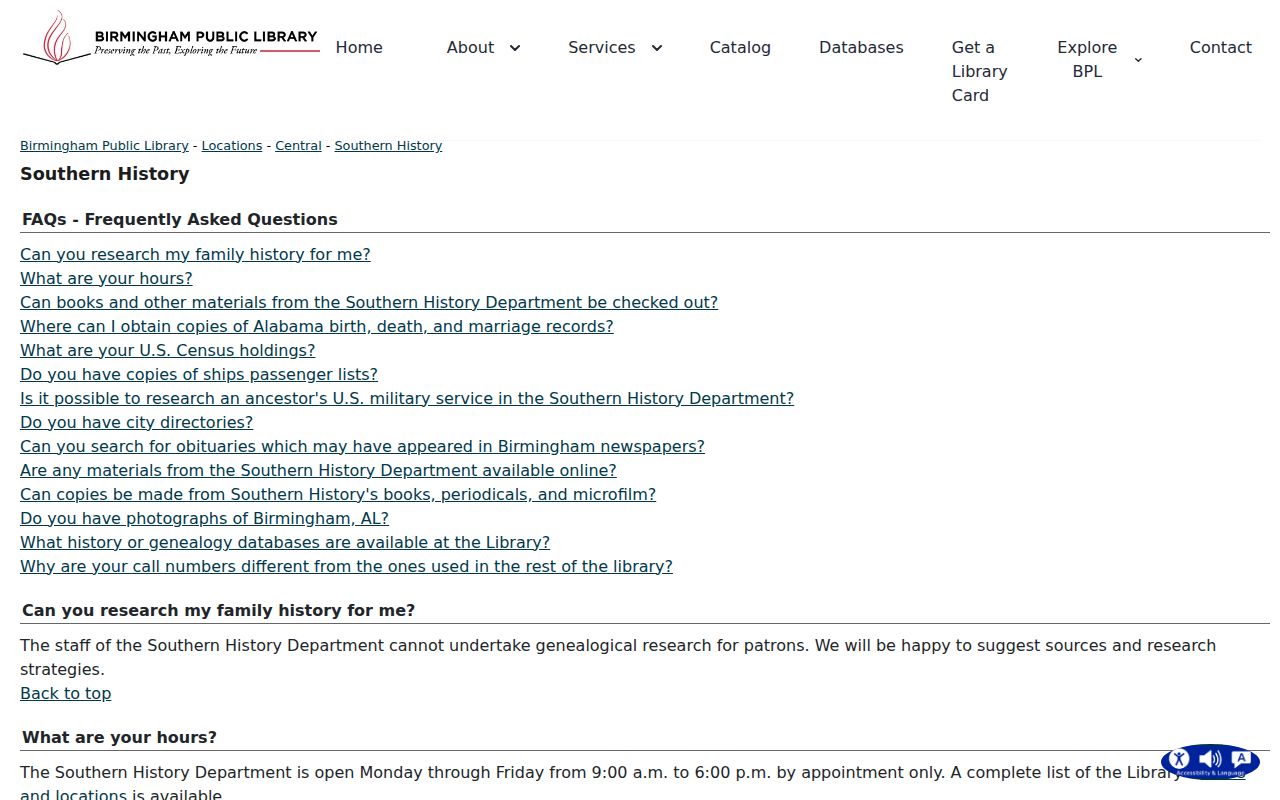
The captured page helps a remote researcher see the rules before choosing an edition. Staff answer specific written requests, normally within 48 hours, but do not undertake broad genealogy or long microfilm searches. Copy work carries a $5 research fee. PDF delivery by email is available, while mailed copies add $0.30 per page and postage. The limit is 20 pages, with prepayment. A request naming one year, person, and address is far more suitable than asking for every person who shares a surname.
Note: Confirm appointment details with Southern History before traveling, since hours and access procedures can change.
Birmingham Digital Directory Doorway
The BPL digital directory collection offers direct online browsing of selected Birmingham items. It is a doorway, not a complete mirror of the reading-room shelf. The verified specialty examples are the 1887 Pocket Business Directory and the 1913 Blue Book. Their audiences and formats differ from a yearly residential directory, so each title page and contents page should guide what can safely be inferred.
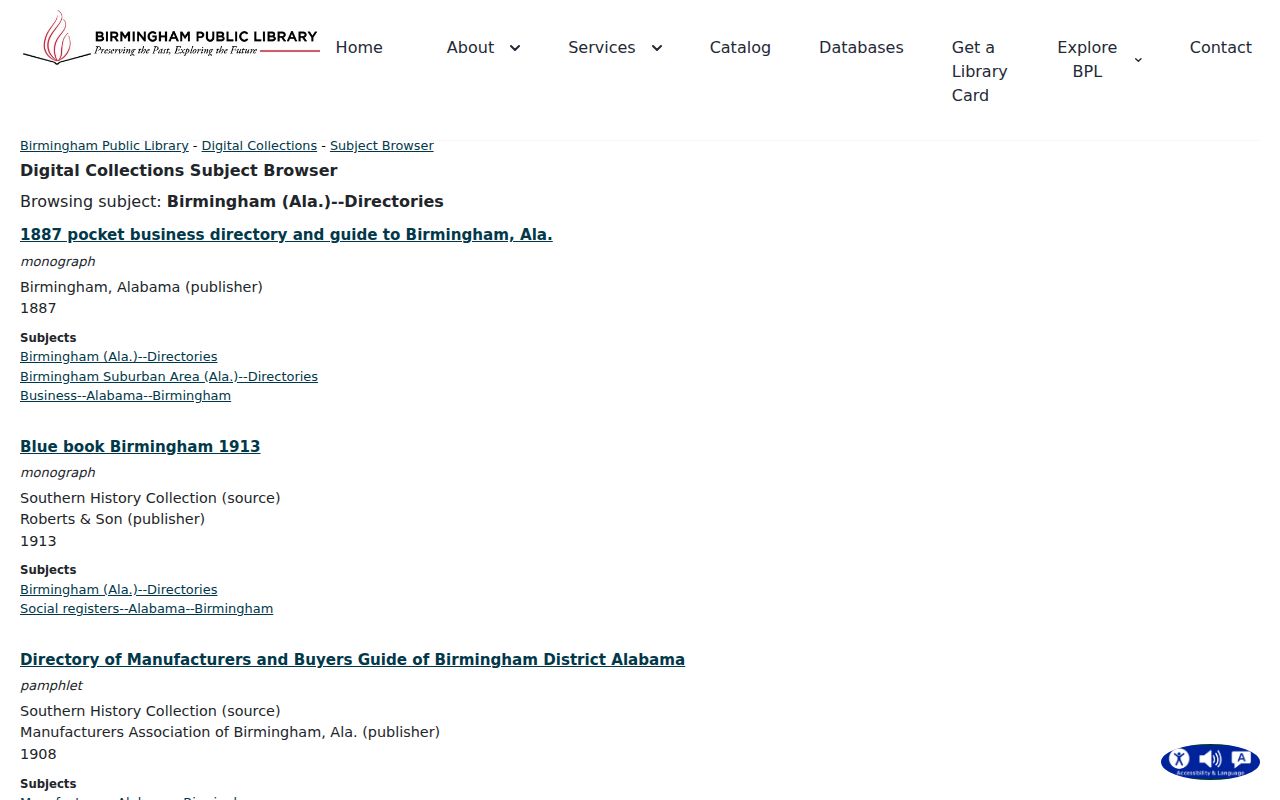
The image shows where the digitized material can be explored from home. Record the item title, publisher, year, page number, and collection name with every finding. That citation matters when two books from the same era list different groups. For volumes that are not online, use Southern History's focused copy service or consult the ADAH Birmingham directory finding aid before visiting the state research room.
Reading Birmingham Directory Entries
No standard Birmingham residential entry or abbreviation key was captured during research. That gap changes how entries should be read. Do not import symbols from a different city's directory or assume that a letter means owner, renter, residence, or boarder. First photograph or cite the selected book's title page and abbreviation key. Then transcribe what the line actually shows before interpreting it.
A careful sample-entry inventory records these fields only when present:
| Personal name | Copy surname, given name, middle form, and punctuation exactly. |
|---|---|
| Household notation | Record a spouse or widow notation as printed, without guessing at kinship beyond the text. |
| Trade or employer | Separate the person's role from the business name and business address. |
| Residence | Copy the house number, street name, and any printed location mark. |
| Edition key | Use that volume's own key before decoding any abbreviation or symbol. |
- Criss-cross directory
- A directory arranged by street or telephone number rather than solely by personal name.
- Householder index
- An address-based list that can identify the named person attached to a house in that edition.
- Abbreviation key
- The publisher's legend for shortened words and marks used in one volume.
An address section is not guaranteed. Verify that it exists in the chosen year. If it does, copy the listed number and nearby numbers, then turn to the alphabetical entries for added context. If not, use a deed, census, or phone book to find a candidate name first.
Birmingham Directory Gaps Matter
BPL identifies four absent publication years: 1933, 1936, 1943, and 1945. These are true gaps in the collection history. They are not proof that a person left Birmingham. A solid directory timeline marks each blank year instead of silently carrying an address forward.
Bridge a missing edition with the nearest directories, a census when one is available, deeds, marriage or probate records, and dated newspaper material. BPL also maintains indexes to local papers and clipping files from the 1930s through the early 1980s. Keep each source in its own row. A deed identifies a party to land, while a directory entry is evidence tied to that publisher's annual snapshot. Neither fact should be changed into the other.
Key distinction. Ownership and occupancy are separate facts. A recorded owner may live elsewhere, while a listed resident may hold no title.
Trace Birmingham Families by Directory
Family research works best when the annual directory is used as a spine. Start with a known year and preserve each spelling, household clue, trade, and address. Then move one edition at a time. Pair the sequence with federal census schedules, which offer broader household snapshots. The newest public federal census is 1950 under the 72-year release rule.
- Find the person's alphabetical entry in one known year and cite the full edition.
- Check the prior and next available editions, noting each change rather than smoothing it over.
- Use an address or reverse section only after confirming the selected volume contains one.
- Compare a directory just before and after each public census year with the census household.
- Use deeds, obituaries, probate files, and newspapers to explain a move, death, or gap.
A useful working timeline might place an 1889 directory entry beside the 1900 census, a 1901 entry, the 1902 Sanborn atlas, and a 1903 deed. That method records both agreement and conflict. When a modern address trail is needed, the Birmingham street directory handles current parcel and address-keyed sources without recasting the old shelf as a live resident roll.
Birmingham Obituary Index Links
An annual directory can establish when a name and address appeared. An obituary may add relatives, an event date, and another place to test. The BPL obituary index covers the Birmingham News, Birmingham World, Methodist Christian Advocate, and Shelby County Reporter. It is a discovery tool, not a complete transcript of every death notice.
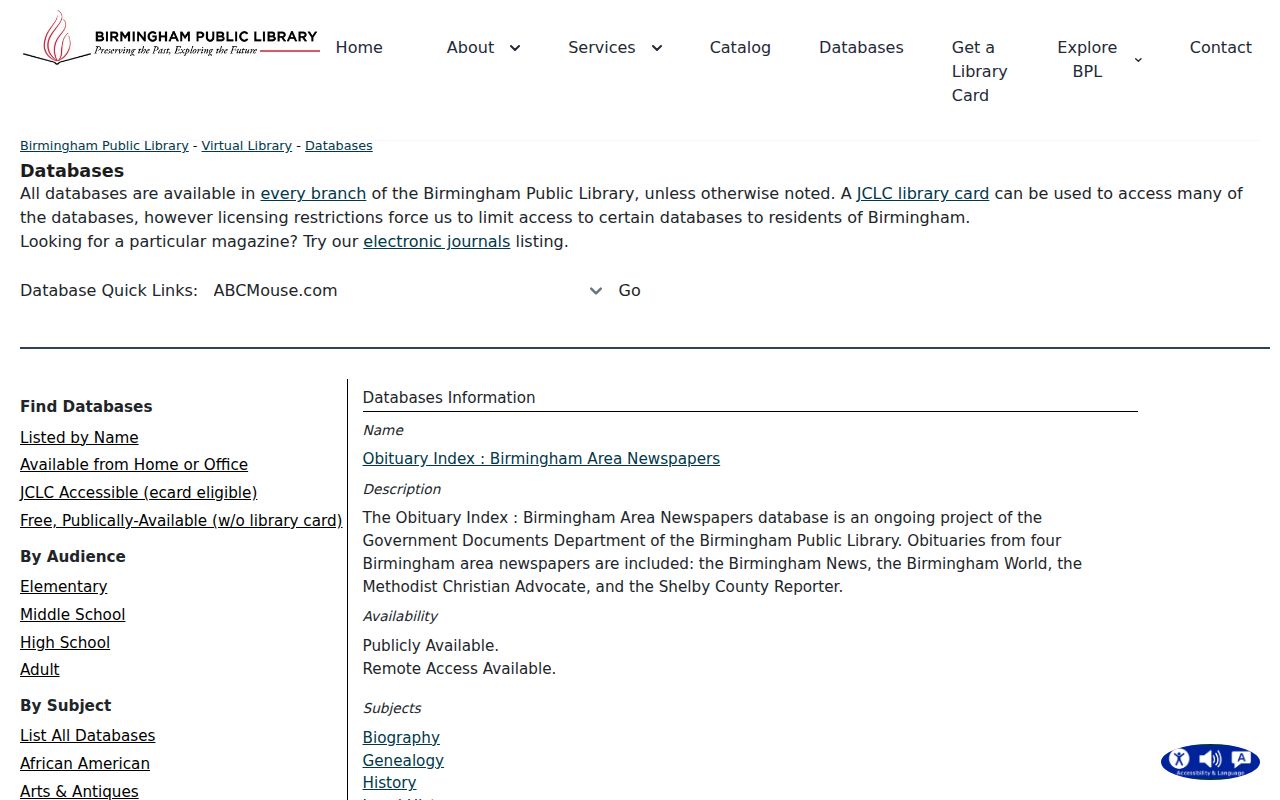
The captured index provides a local next step when a person vanishes from a directory sequence. BPL's Birmingham News index covers 1978 through 1993, with obituary indexing from 1975 onward, while the Post-Herald index covers 1979 through 1992. A miss in an index does not prove the paper lacks an item. If a likely date is known, ask Microforms to check the named paper and date.
Birmingham Telephone Directory Geography
A June 1971 South Central Bell white-pages example in the Library of Congress includes Birmingham and surrounding communities such as Bessemer, Hueytown, and McCalla. It demonstrates why a telephone directory cannot be collapsed into a Birmingham resident roll. Service and exchange geography can cross city lines. People without service or with unlisted numbers can also be absent.
Use phone books as companion evidence. They can provide a name, address, and number, but they may omit the spouse, trade, or employer found in a residential volume. A phone listing also needs its own date and geographic label. When a current record must be tested against the old trail, the Birmingham resident lookup process separates official property, court, vital, and voter sources.
Note: Treat every directory footprint as publisher-defined until its title page and coverage statement show otherwise.
Birmingham Archives Beyond Directories
The BPL city directory holdings page places the annual run within a much larger local history collection. Birmingham designated BPL Archives & Manuscripts as City Archives in 1987. The repository reports more than 400,000 photographs and 30 million documents. Board of Education directories from 1920 through 1924 and 1950 through 1981 can restore institutional ties that a household book missed.
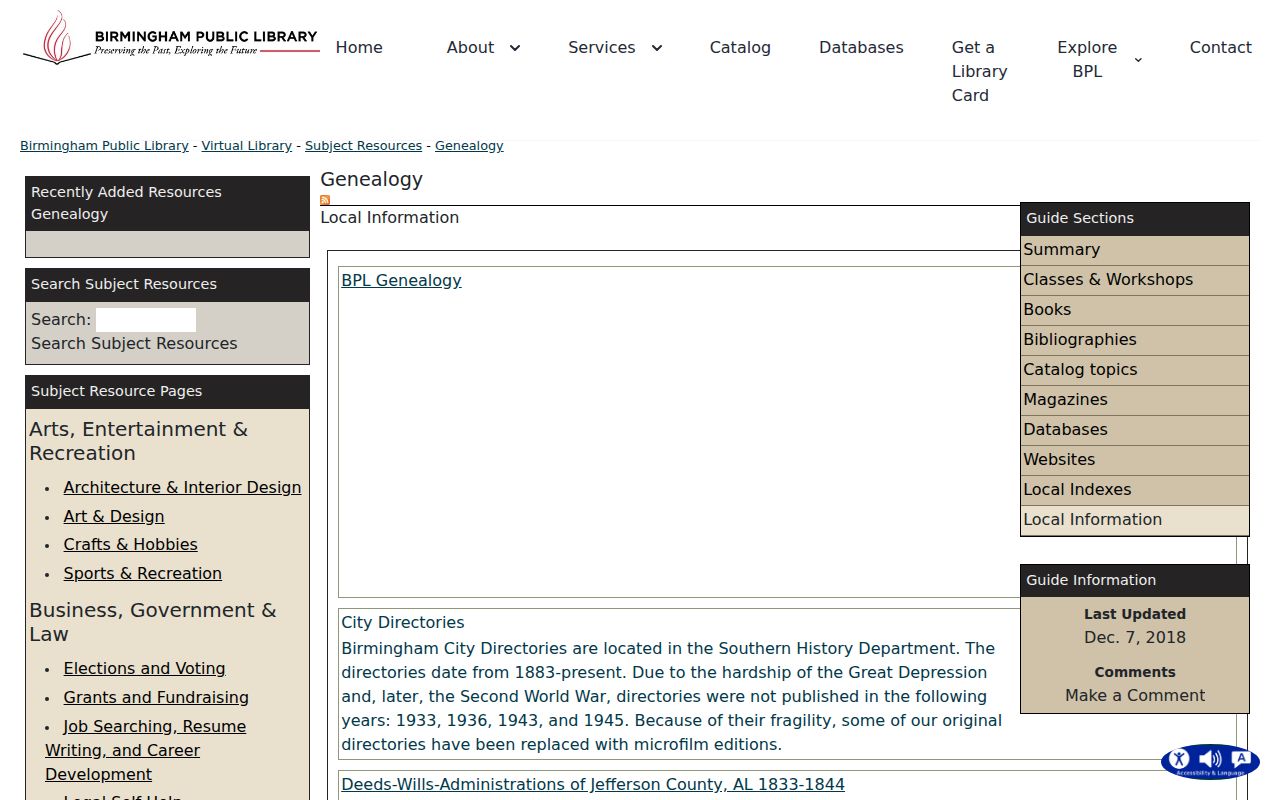
The screenshot anchors the directory years to the library's own description. Other local tools include BPL’s deed, will, naturalization, and county-minute indexes, marriage books, clipping files, the Red Mountain Cemetery interment list, and a coal-mine fatalities database with 2,188 records from 1898 through 1938. UAB archives add nursing-school ledgers, physician biographies, hospital records, scrapbooks, and oral histories. The Birmingham Civil Rights Institute accepts appointment-based archive questions about people, churches, movement groups, photographs, and events.
These sources should supplement a directory entry, not be forced into its format. Hospital and nursing records may identify a resident through an institution. A cemetery item may explain why a name stops. A court or marriage index can supply a new surname. Each link is strongest when the name, date, place, and record role agree across at least two sources.