
Finding Birmingham Residents Stepwise
A Birmingham residents directory search works best as a chain. A name can lead to an owner record in Jefferson County CAPture, then to a parcel in GIS, and then to a recorded deed in Probate Court’s LANDMARK system. An address-first search follows the same chain in reverse. When the question concerns an earlier household, Birmingham Public Library directories and census schedules become stronger than the current roll. An estate question may call for probate files and the library obituary index. A municipal citation, state trial case, and federal case each belong to a different court source.
No official Birmingham roll lists every adult, renter, or household member. Ownership does not prove occupancy. A voter’s self-service confirmation is not a public neighbor browser, and a registered-agent address may be a service address. Match at least two independent facts, such as a middle name, spouse, parcel description, occupation, or address chronology. Label a lone same-name result as a possible lead, not a confirmed resident.
- Search CAPture by owner or property address, then compare the situs and mailing addresses.
- Open Jefferson County or Birmingham GIS to verify the parcel, legal description, division, and municipality.
- Search LANDMARK for the owner’s acquisition deed and use the legal description to reject unrelated name matches.
- Check the correct court, vital, voter, business, or license custodian for a second fact.
- Move to Birmingham Public Library or a narrow records request when an online cutoff ends the trail.
Use records lawfully. Birmingham public records support family research, estate work, scam checks, and civic inquiry. Never use a directory search to stalk, threaten, or harass anyone.
Birmingham Resident Record Keepers
Resident evidence is split by office and jurisdiction. Jefferson County Probate Court records deeds, mortgages, plats, marriage certificates, wills, and estates. The Tax Assessor maintains the current property roll, while county and city GIS services add parcel boundaries and municipal context. The Board of Registrars keeps voter records. Birmingham City Clerk is the fallback for a specific city record without a verified public index. Circuit and District Court files sit with the Circuit Clerk, and Birmingham Municipal Court keeps its own local files. A full address method belongs in the Birmingham street directory; the key first step here is choosing the custodian that created the fact.
Jefferson County Probate Recording
716 N. Richard Arrington Jr. Blvd.
Birmingham, AL
205-325-5411
Jefferson County Tax Assessor
Current real-property roll
Owner, situs, parcel, and values
Web and counter access
Jefferson County Board of Registrars
Current county voter list
Registration and address changes
County custodian
The Probate Court has Birmingham and Bessemer divisions. The proper division affects the courthouse, the older books, and the online coverage date. For a city-only file, the Birmingham City Clerk request process requires a specific existing record, the city form, and proof of Alabama residency. Requests are mailed or hand-delivered under the published procedure.
Birmingham CAPture Resident Clues
Jefferson County’s CAPture portal is often the quickest name-to-address route for an owner. It offers separate search modes for Property Address, Mailing Address, Owner, and Parcel. The owner mode uses last name then first name. Address mode starts with the street number and name. Parcel input drops spaces and punctuation. Results should be carried into GIS, where the legal description, division, plat, and municipal fields can distinguish similar names.
The two address fields answer different questions. A situs address locates the land. A mailing address tells where the tax owner receives correspondence. Matching addresses may support an owner-occupancy theory, while different addresses can suggest an out-of-area mailing point. Neither result proves who sleeps at the property. Exemption fields and building indicators are supporting clues, not a Birmingham residents directory of occupants.
| CAPture field | How to use it | Required | Important limit |
|---|---|---|---|
| Property Address | Street number, then street name | One search choice | Identifies the parcel location |
| Mailing Address | Search correspondence address | One search choice | May differ from the property |
| Owner | Last name, then first name | One search choice | Owner is not always occupant |
| Parcel | Remove spaces and periods | One search choice | Best for an already known parcel |
Note: The county parcel layer refreshes nightly, so compare a very recent transfer against LANDMARK’s recording date.
Two Jefferson Records Divisions
Birmingham and Bessemer are separate Probate Court search paths. That division is more than an office label. LANDMARK’s Birmingham index begins in 1987, with online images beginning in 1993. The Bessemer division has both index data and images from 1965 forward. Older Birmingham land books and maps reach into the 1800s at the courthouse, while Bessemer holdings reach to 1915. A record outside a web cutoff may still exist on paper.
First identify the division from the parcel or document. Then use the matching index and courthouse. An unregistered LANDMARK user can search data and view a watermarked first image page. Registered image access costs $2 per page, while a subscriber plan has a monthly charge and a lower page price. At the Record Room, a copy is $1 per page, plats are $15 per page, and certification adds $2 per document. Staff cannot conduct a title search or prepare a deed.
| Search path | Index begins | Images begin | Offline fallback |
|---|---|---|---|
| Birmingham Division | 1987 | 1993 | Birmingham Record Room |
| Bessemer Division | 1965 | 1965 | Bessemer courthouse |
Birmingham LANDMARK Resident Trail
The Jefferson County LANDMARK index turns a parcel owner into a document trail. Search routes include Name, Document, Book/Page, Consideration, Record Date Range, Instrument Number, Legal, and Quick Search. A name search takes a name and optional date limits. Document mode adds a type and optional category. Book/page or instrument number is better when another source already supplied an exact citation.
The deed-index screen below shows the official entry point. It is useful for finding recorded parties and chronology, but the index is a courtesy rather than the official instrument.
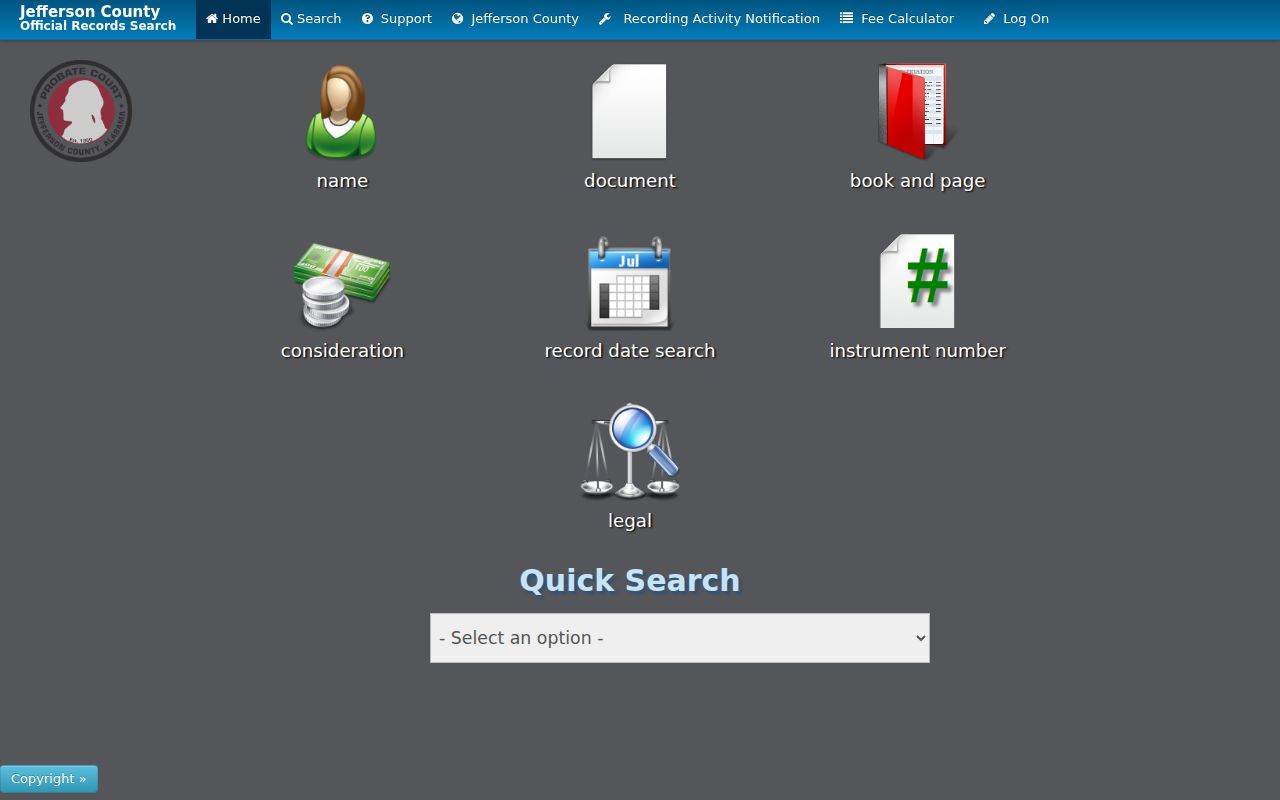
Carry the instrument into the image or Record Room and compare its lot, block, subdivision, and legal description with GIS. A stable land description is stronger identity evidence than the same name appearing elsewhere in Jefferson County. Deeds prove a recorded property role. They do not name every Birmingham resident or renter at an address.
- Index
- A finding aid that points to a stored record.
- Parcel
- A mapped unit of land identified for assessment and records.
- Grantor
- The party transferring an interest in a recorded deed.
- Grantee
- The party receiving that recorded interest.
Alabama Voter Lookup Boundaries
Alabama VoterView can let a voter confirm registration status, ballot status, polling location, and address. Its Polling Place Search takes a full street address. Alabama does not register voters by party, so a registration result cannot establish party affiliation. Address changes require a new application, and registration closes fourteen days before an election.
The self-service tool is not a public Birmingham resident or neighbor browser. Jefferson County’s Board of Registrars maintains the current list, while the Secretary of State provides a separate statewide list-order process under Ala. Code § 17-4-38. Electronic ASCII or Excel output costs one cent per voter record. Protected residence and mailing addresses can be omitted for qualifying domestic-violence applicants and certain covered officials. Participation history, when lawfully released, can show that a person voted, never the choice made.
Note: Use VoterView for the voter’s own confirmation; do not imply that it reveals other people living along a Birmingham street.
Current Birmingham Resident Rolls
Current Birmingham directory work depends on official lists built for different public duties. The assessor roll identifies owners and land. Recorded instruments identify parties to deeds, liens, mortgages, plats, powers, and some marriage filings. Court indexes identify parties and case activity within one jurisdiction. License boards confirm a regulated professional’s public status. VoterView confirms the voter’s own record, while a separately ordered voter list is governed by state law. None is a complete household census.
| Birmingham source | People represented | Official keeper | Access route |
|---|---|---|---|
| CAPture property roll | Named property owners | Jefferson County Tax Assessor | Free portal or counter |
| LANDMARK recording index | Parties to recorded instruments | Jefferson County Probate Court | Free index, paid images, or record room |
| Voter record | Registered voters, subject to protection | Board of Registrars and Secretary of State | Self-lookup or statutory list order |
| State trial case index | Parties in available case categories | Jefferson County Circuit Clerk | Paid portal, mail, or counter |
| Professional license record | Licensed practitioners by board | Alabama licensing boards | Free board-specific lookup |
Choose the roll by the fact it was made to record. CAPture answers who holds assessed title, not who occupies a home. LANDMARK answers who appears on a recorded instrument. A license search confirms status and board history, not a home address. The one-person sequence and confidence rules appear in the Birmingham resident lookup. Commercial directory products may merge old and current feeds, so treat that category only as an unverified lead.
Choosing Birmingham Court Record Routes
A court search starts with jurisdiction. Birmingham Municipal Court handles city ordinances, misdemeanors, and traffic within its jurisdiction. No public party-name municipal docket was verified, so contact its customer service or use the city records-request path. Jefferson County Circuit and District Court cases appear through the paid Just One Look service and remain available from the Circuit Clerk by a focused search or copy request. Estates, wills, guardianships, and related probate matters belong to Probate Court. Federal dockets for the Northern District of Alabama use PACER.
The Just One Look court search offers name and case-number modes across listed criminal, civil, small-claims, state-traffic, domestic-relations, and child-support categories. The search costs $9.99 and includes one case detail. The official detail may include court basics, status, settings, party roles, actions, financial entries, chronology, and available images.
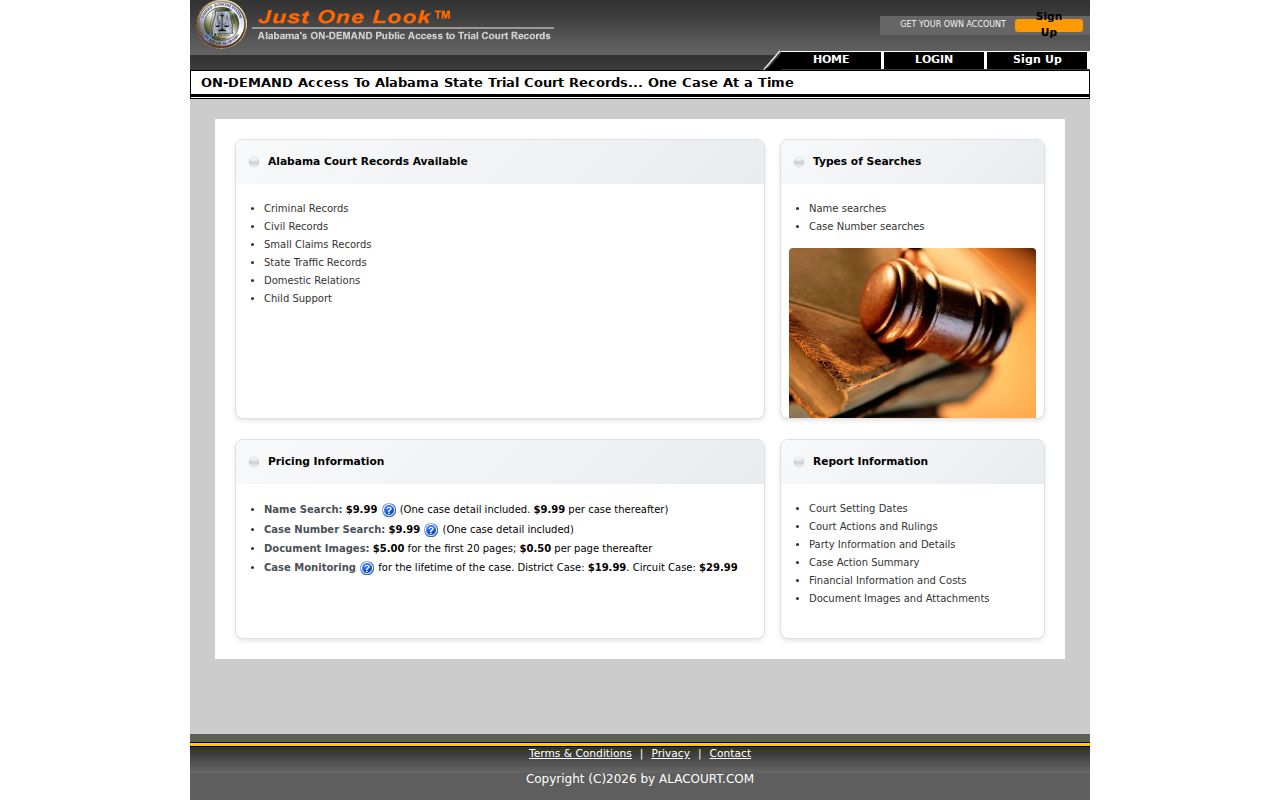
The screen shows why a known case number is safer than paying for repeated broad-name searches. Juvenile, adoption, sealed, expunged, and other protected matters may not appear. Absence online is not proof that no file exists.
Birmingham Vital Record Limits
Alabama’s vital system began statewide registration in 1908. Birth certificates remain restricted for 125 years and death certificates for 25 years under Ala. Code § 22-9A-21. Marriage and divorce certificates are nonconfidential. Eligible applicants can use the Jefferson County Department of Health for statewide certificates, while the Alabama Center for Health Statistics handles the state system. The first search or copy costs $15, including a failure-to-find result, and each additional copy of the same record costs $6.
Dates determine the custodian. State marriage certificates begin in August 1936; earlier Jefferson County marriages lead to Probate Court books and indexes. State divorce abstracts begin in 1950, but an actual decree or older divorce file comes from the Circuit Clerk. Birmingham Public Library holds historical death, marriage, and divorce indexes that can supply a discovery fact without claiming access to a restricted certificate. Pre-1908 work may depend on church registers, cemetery records, newspapers, and probate books.
Note: A certificate abstract can confirm an event, but it does not replace the pleadings and decree in a court file.
Birmingham License Identity Clues
Alabama has no single verified professional-license umbrella. Search the board responsible for the occupation. The Medical Licensure Commission search accepts first, middle, and last name, license number, type, status, dispensing registration, and permitted location. Public results can show status, dates, school, controlled-substance authority, collaborators, and permanent public actions. Confidential complaints, investigations, full private addresses, and birth dates remain withheld.
The Alabama medical license lookup is one official example of a board-specific resident clue.
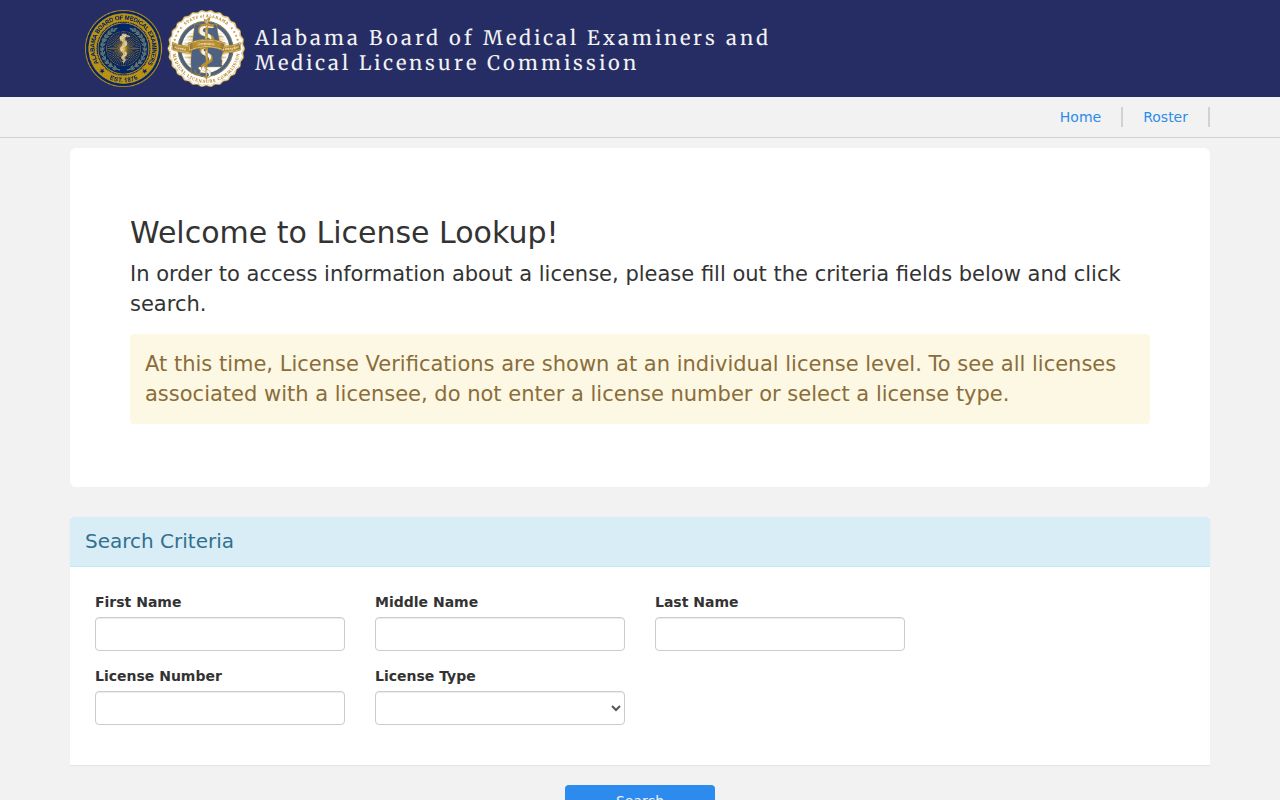
The fields help separate professionals who share a name, yet a permitted location may be a practice site rather than a home. Nursing records use license-number or name modes and return public status, issue, expiration, compact type, and encumbrance history. For a Birmingham business, compare an Alabama Secretary of State entity role with the city’s license custodian. An officer, incorporator, or registered agent is not automatically the owner or a resident at the filing address.
Historic Birmingham Resident Directories
Birmingham Public Library’s Southern History Department holds city directories from 1883 to the present, with no volumes published in 1933, 1936, 1943, or 1945. The collection starts only twelve years after Birmingham’s founding. Annual entries can trace a name, spouse notation, occupation, employer, and residence when the chosen volume supplies those fields. An address or reverse section must be verified within the volume before treating it as a criss-cross directory.
The shelf is reference-only at the Linn-Henley Research Library. Southern History works by appointment on weekdays and answers focused written requests, normally within 48 hours. Its copy service charges a $5 research fee, limits requests to 20 pages, and can send a PDF. A request for one person or address in a named year fits those rules better than a broad surname sweep. The Alabama Department of Archives and History adds a discontinuous Birmingham run from 1888 through scattered editions as late as 2007.
The four publication gaps are not proof that a household left the city. Bridge them with deeds, newspapers, voter evidence, or a census year. The complete shelf methods, publisher runs, and entry cautions are handled on the Birmingham city directory page.
Birmingham Archives Fill Directory Gaps
In 1987, Birmingham City Council designated Birmingham Public Library Archives and Manuscripts as the City Archives. The repository reports more than 400,000 photographs and 30 million documents. Its maps, letters, diaries, scrapbooks, architectural drawings, and government or business records can restore a person’s context when ordinary directory entries stop. Board of Education directories cover 1920 through 1924 and 1950 through 1981.
Other Birmingham sources are equally specific. The library obituary index searches the Birmingham News, Birmingham World, Methodist Christian Advocate, and Shelby County Reporter. Its Coal Mine Fatalities database contains 2,188 records from inspection reports dated 1898 through 1938. UAB archives hold hospital, nursing-school, medical-biography, scrapbook, and oral-history materials. Birmingham Civil Rights Institute’s appointment-based archive connects names to movement groups, churches, photos, periodicals, and events.
These are historical affiliations, not current contact lists. Use a directory or institutional record to establish the era, then corroborate the same person through an obituary, census household, deed, probate file, or another dated source.
Exact Birmingham Records Requests
When no public index exists, ask the office for a specific existing record. Birmingham City Clerk accepts the city form by mail or hand delivery and requires an Alabama-residency certification with acceptable proof. The office publishes a standard acknowledgement period of ten days and a substantive-response period of fifteen business days after acknowledgement, subject to extensions. Time-intensive requests follow a longer fee-notice and response cycle. A clarification restarts the clock.
The Birmingham public-record request instructions show the official route and its residency rule.
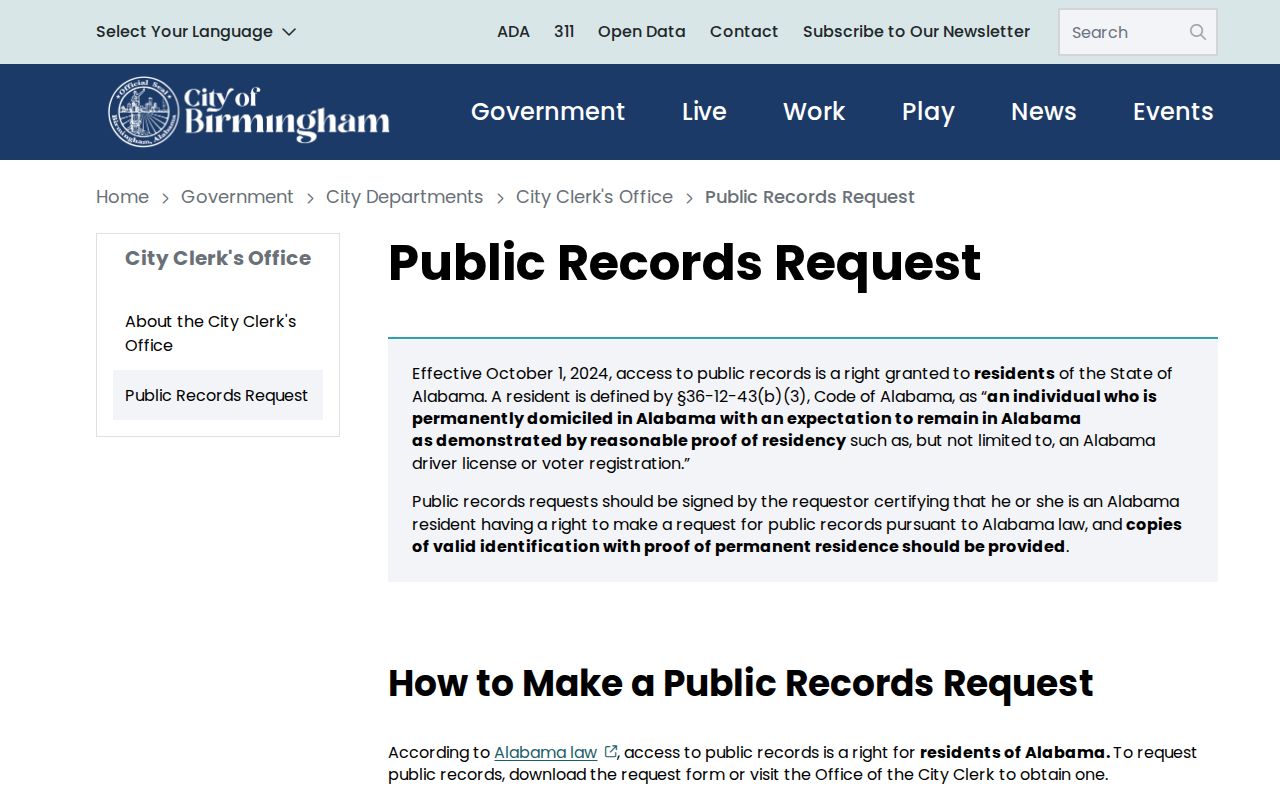
The form works best with a record type, office, names, a date range, and an identifier such as case, instrument, or parcel number. Alabama Public Records Law begins at Ala. Code § 36-12-40. Act 2024-278 added the current request procedures and resident-only statutory right effective October 1, 2024. An agency may charge reasonable direct costs and need not create a new record to answer a question. State-level requests follow the Secretary of State’s published records policy.
Birmingham Property Fraud Alerts
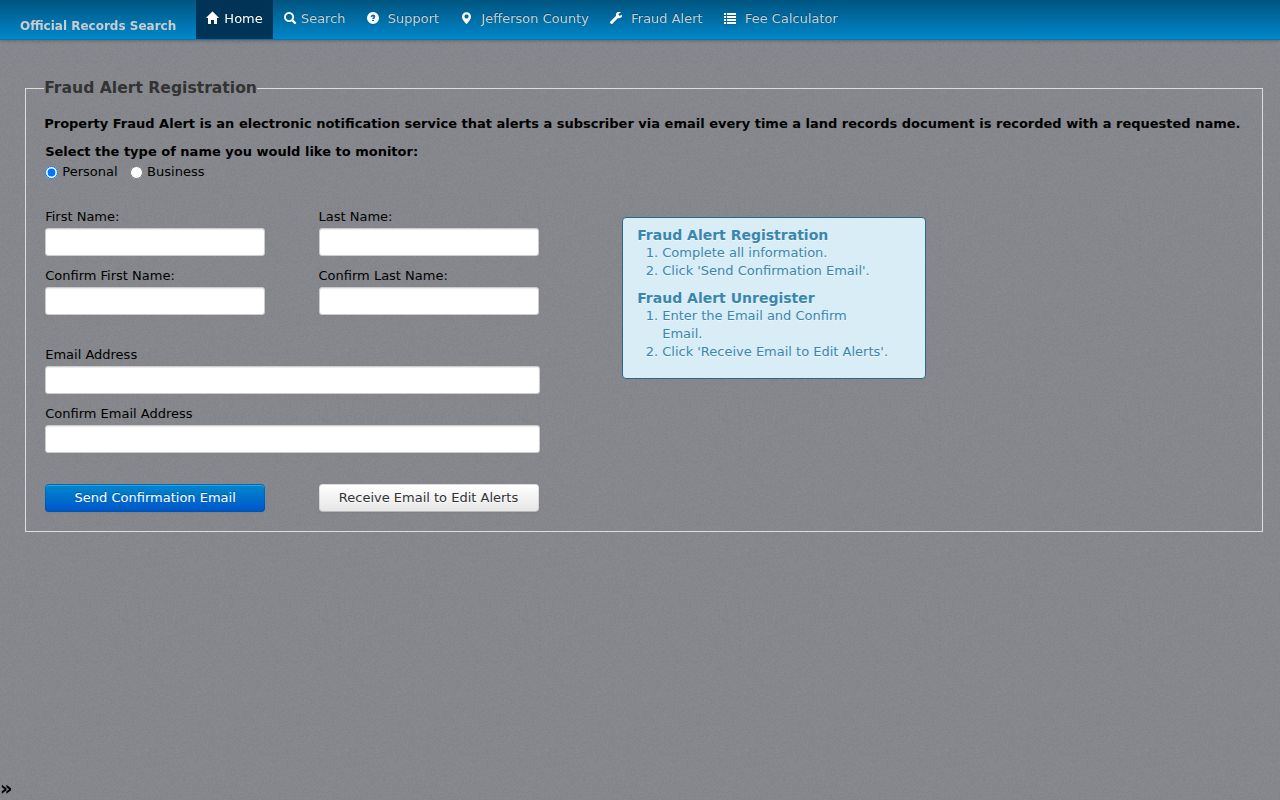
Jefferson County’s free Property Fraud Alert watches newly recorded documents for a personal or business name. Personal enrollment asks for first and last names with confirmations, plus an email address and confirmation. Business enrollment uses the business name. The system emails a confirmation, and a separate route sends an edit or unregister link. It detects a new name match; it does not block a filing, validate a deed, or prove fraud.
The Property Fraud Alert enrollment screen provides a practical watch on Birmingham and Jefferson County recording activity.
Common names can produce unrelated notices, so compare every alert with the instrument, parcel, and legal description. This matters in light of Jefferson County’s July 2026 permit-phishing warning: scammers used real permit facts and public officials’ names before demanding wire, peer-to-peer, or cryptocurrency payments. Verify any demand through an independently sourced county contact, and use the Alabama Attorney General complaint channel for an appropriate consumer report. Official recording data can help spot a scam, but its public detail can also be misused.